
Case Study: BOM Travel B2C Platform – Powered by Tripstacc
1. Product Vision
The BOM Travel B2C Platform – Powered by Tripstacc was envisioned as a consumer-first digital travel ecosystem designed to enable users to search, compare, and book travel services seamlessly while leveraging exclusive benefits tied to Bank of Maharashtra credit cards. The objective was not simply to build a booking interface but to create a high-conversion, trust-driven platform that integrates financial incentives with a frictionless user experience.
Unlike generic travel platforms, this system needed to tightly connect banking-driven offers with real-time travel booking workflows, ensuring that users clearly understand the value they receive at every stage. The platform was designed to function as a guided journey, leading users from discovery to booking without confusion, unnecessary steps, or performance delays.
At the same time, scalability was a key consideration. The system needed to support future expansion into hotels, packages, and additional services while maintaining performance, consistency, and usability across devices.
2. Problem Discovery (User Behavior & Business Gaps)
During the initial analysis, it became clear that most B2C travel platforms suffer from a mismatch between user expectations and system behavior. Users are often overwhelmed by complex interfaces, unclear pricing structures, and disconnected booking flows. This problem becomes even more critical when financial incentives such as credit card offers are involved, as users are unable to clearly understand or apply these benefits.
A major issue observed was drop-offs during the booking journey, primarily due to unclear steps, hidden costs, or slow system performance. Mobile users, who represent a significant portion of traffic, often face usability issues due to poor optimization and cluttered layouts.
From a business perspective, there was a clear gap between marketing campaigns and actual system behavior. Offers promoted externally were not effectively integrated into the booking journey, leading to missed conversion opportunities. Additionally, limited analytics and tracking capabilities made it difficult to optimize performance or understand user behavior.
These findings highlighted that the solution required not just feature implementation, but a strong focus on clarity, structured workflows, and seamless integration of business logic into user experience.
3. Product Structuring (Before Design)
Before moving into design, the BOM Travel B2C Platform – Powered by Tripstacc was structured into clearly defined modules to ensure scalability and maintainability. Core modules included search and discovery, booking engine, pricing and offer integration, payment processing, and user account management.
A detailed mapping of the user journey was conducted to ensure that each step—from initiating a search to completing a booking—is logically connected and easy to follow. Special attention was given to embedding credit card benefits directly into the booking flow so that users can view and apply offers without additional complexity.
The system was designed to support multiple booking scenarios, including one-way, round-trip, and multi-city travel. Each flow was optimized to reduce user effort while maintaining flexibility for different travel needs.
A mobile-first approach was adopted at this stage itself, ensuring that all flows are designed primarily for mobile usage and then scaled for desktop.
4. UX & Figma Design (User Experience Layer)
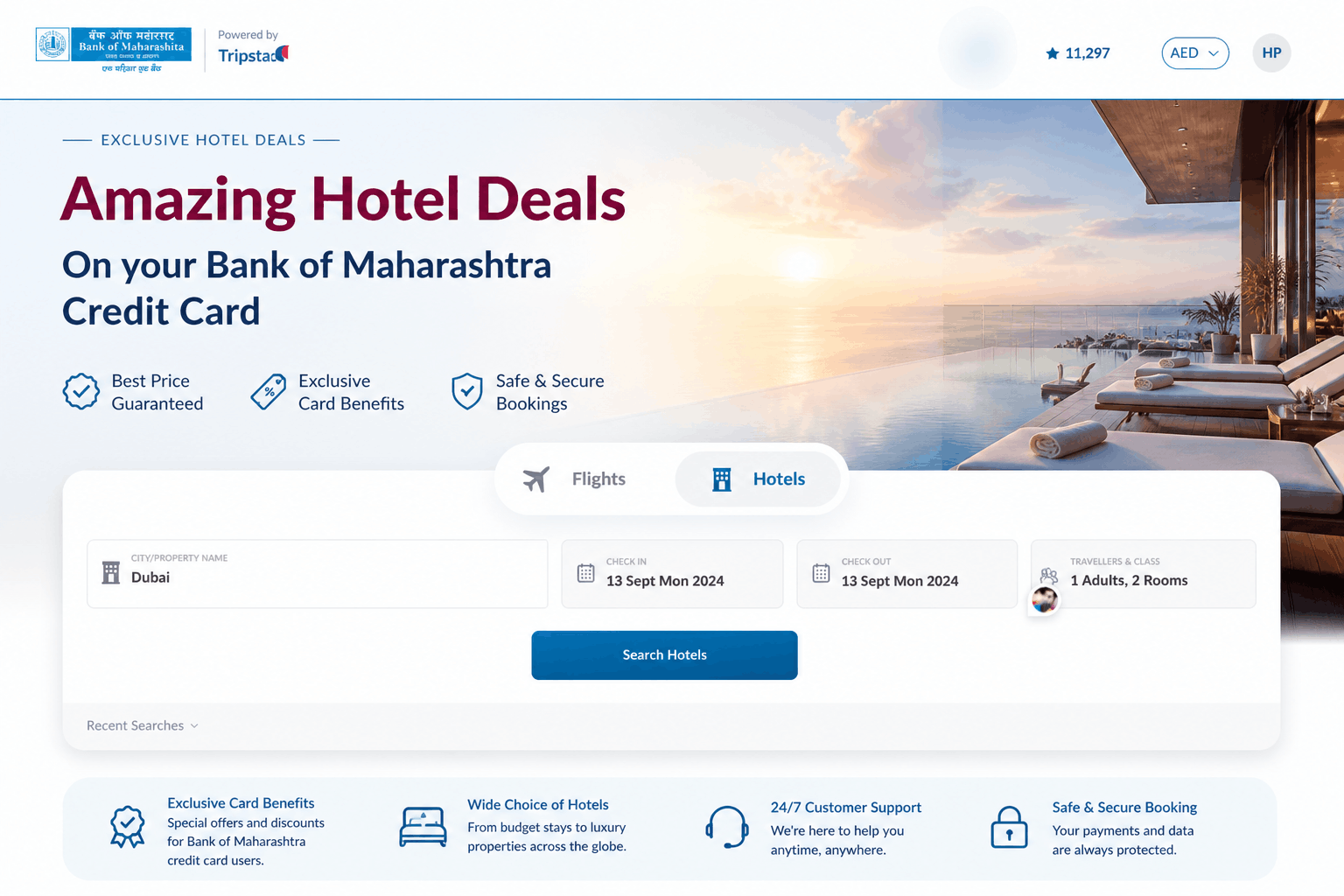
The UX design phase focused on creating a clean, intuitive, and conversion-focused interface. The homepage of the BOM Travel B2C Platform – Powered by Tripstacc was designed as a high-impact entry point, highlighting key offers, search functionality, and trust indicators.
The search module was designed to be simple yet powerful, allowing users to quickly input travel details and initiate searches without confusion. The booking journey was structured as a guided, step-by-step process, ensuring that users always know what to do next.
Transparency in pricing was a key focus, with clear breakdowns provided to eliminate confusion and build trust. Visual elements such as icons, travel imagery, and structured layouts were used to enhance engagement without affecting performance.
Mobile design was treated as a primary experience, with optimized navigation, touch-friendly interactions, and simplified layouts ensuring seamless usability across devices.
5. Development Phase (System Execution & Architecture)
The BOM Travel B2C Platform – Powered by Tripstacc was developed using a modular, API-driven architecture to ensure scalability and performance. The frontend was optimized for speed and responsiveness, while the backend handled complex operations such as search queries, pricing calculations, and booking management.
Integration with external travel APIs enabled real-time access to flight data, ensuring accuracy and reliability. The booking engine was designed to handle multi-step transactions securely, with robust error handling and data validation at each stage.
Payment integration was implemented with a strong focus on security and reliability, ensuring smooth and safe transactions for users. Performance optimization techniques such as caching and efficient data handling were applied to maintain system responsiveness even under high traffic conditions.
6. Testing Phase (Real-World Validation)
Testing for the BOM Travel B2C Platform – Powered by Tripstacc was conducted with a strong focus on real-world user behavior. Instead of testing individual features in isolation, complete booking journeys were validated to ensure end-to-end reliability.
Different user scenarios were tested, including first-time users, repeat users, and users applying credit card offers. Edge cases such as payment failures, incomplete bookings, and session expirations were thoroughly evaluated.
Mobile testing was given high priority to ensure consistent performance across devices. User acceptance testing was conducted using real-world scenarios to validate both usability and system behavior.
7. Go-Live Strategy
The go-live strategy followed a phased approach to reduce risk and ensure system stability. The BOM Travel B2C Platform – Powered by Tripstacc was initially deployed in a controlled environment with limited traffic, allowing for performance validation and issue identification.
Traffic was gradually increased while continuously monitoring system behavior. Any issues identified during early stages were resolved quickly to ensure a smooth transition to full-scale production.
Performance monitoring tools were implemented to track system health and ensure reliability during peak usage.
8. Post-Launch Optimization
After launch, the focus shifted to optimizing the BOM Travel B2C Platform – Powered by Tripstacc based on real user data. User behavior analytics were used to identify drop-off points and improve conversion funnels.
Enhancements were made to search performance, pricing clarity, and mobile usability. User feedback was incorporated to refine the experience and ensure continuous improvement.
Regular updates were implemented to maintain system stability and introduce new features aligned with user needs and business goals.
9. Key Features & Capabilities
The BOM Travel B2C Platform – Powered by Tripstacc provides a comprehensive set of features designed to enhance user experience and business efficiency. Users can search and compare flights, view real-time pricing, and complete bookings through a secure and streamlined process.
The integration of credit card benefits ensures that users receive additional value while booking. The platform also supports personalized recommendations, intuitive navigation, and responsive design.
Customer support integration ensures that users can access assistance when needed, improving overall satisfaction and trust.
10. Business Impact
The implementation of the BOM Travel B2C Platform – Powered by Tripstacc resulted in significant improvements in user engagement and conversion rates. Simplified booking flows reduced drop-offs, while clear communication of offers increased user trust.
The mobile-first approach ensured higher engagement from mobile users. From a business perspective, improved analytics and tracking enabled better decision-making and optimization.
The platform’s scalable architecture allows for future expansion without major structural changes.
11. Strategic Insight
The success of the BOM Travel B2C Platform – Powered by Tripstacc demonstrates that user experience must be tightly aligned with business logic. A visually appealing interface alone is not sufficient; the system must support seamless workflows and clear communication.
Integrating promotional offers directly into the booking journey proved to be a critical factor in improving conversions. Additionally, focusing on mobile-first design ensured better engagement and usability.
12. Final Outcome
The BOM Travel B2C Platform – Powered by Tripstacc evolved into a scalable, high-performing system that delivers a seamless travel booking experience. It successfully combines performance, usability, and business logic to create a platform that meets both user and organizational needs.
Conclusion
This case study highlights that successful B2C platforms are built through structured workflows, user-centric design, and scalable architecture. The BOM Travel B2C Platform – Powered by Tripstacc demonstrates how clarity, simplicity, and real-world usability can transform a booking system into a high-conversion digital product.